Printing and file preparation / 2 min read
How Can School Leaders Cut Paper Waste Without Making Worksheets Harder to Read?
School leaders can reduce paper waste by printing the correct versions and quantities, choosing appropriate sides and reviewing unused copies.
Published / Updated
By BizBee editorial. Editorial review: Ibrahim — source and calculation checks.
Short answer
School leaders can reduce paper waste by printing the correct versions and quantities, choosing appropriate sides and reviewing unused copies. Shrinking every worksheet is not a reliable strategy: it can remove writing space and make diagrams harder to use. Measure useful classroom output rather than paper reduction alone.
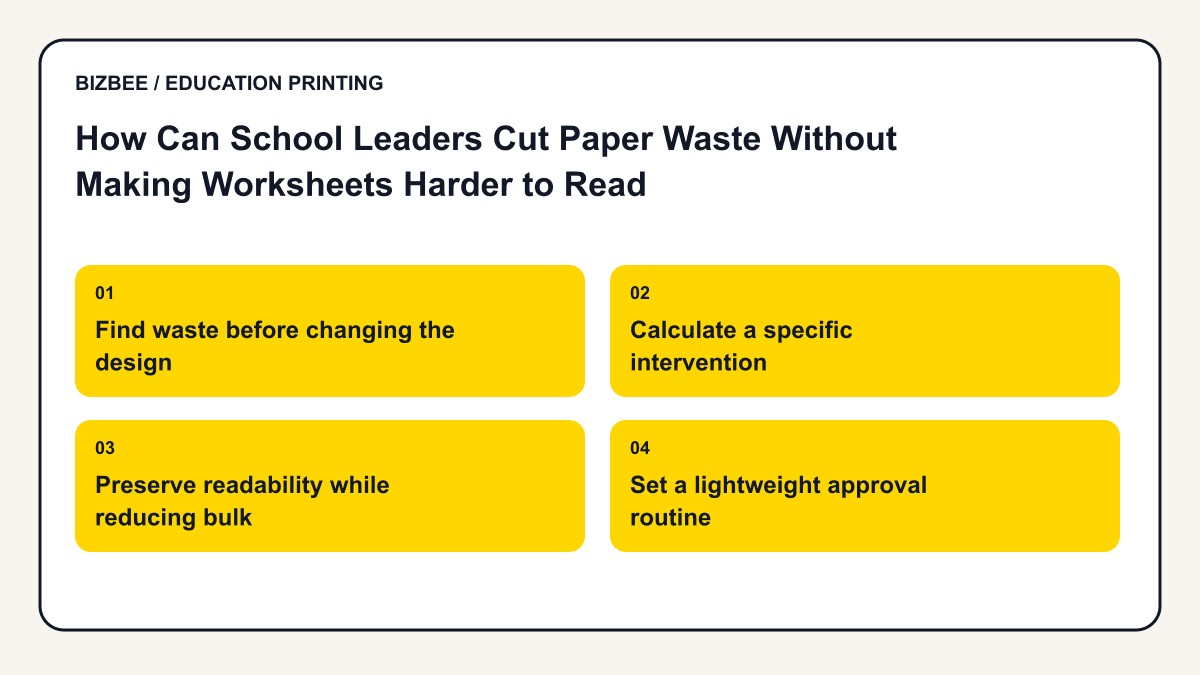
Find waste before changing the design
Ask teachers to record obsolete versions, duplicate orders, excessive spares and pages left unused. These are different problems from high but necessary classroom use. Keep a simple record without collecting pupil-level information that the print review does not need.
A lesson requiring individual written practice may reasonably use more paper than a shared reading task. Compare like activities rather than rewarding the lowest page count regardless of teaching purpose.
Use this supporting guide for the underlying print setup; the education workflow above defines this article’s specific task.
Calculate a specific intervention
Illustrative example: four classes each print five unnecessary spare copies of a four-page pack every week. Removing that unused buffer saves 80 printed faces weekly. Across eight similar weeks, that is 640 faces not printed.
That is a planning calculation, not a claim about a real school’s savings or environmental footprint. Verify actual unused copies before changing the buffer, and retain enough replacements for the activity.
Preserve readability while reducing bulk
Use duplex where the activity supports it, but do not pair cutting sheets or place answers on the reverse without teacher approval. Check diagrams, line spacing and physical scale before using smaller pages or multi-up output.
A correct-size worksheet printed once is often more useful than an unreadable reduced sheet that must be printed again. Ask for a representative proof when a format change affects measurements or writing space.
Set a lightweight approval routine
Name an owner for each file, a version cut-off and a receiving contact. Combine stable work only where timing and quantities justify it. Review current Dubai delivery options against the school timetable rather than assuming batch orders always arrive earlier. After a term, compare unused packs, correction reprints and actual totals to decide which changes are worth keeping.
Find related classroom, student and academic planning questions.
Your decision checklist
- - Record actual unused copies
- - Remove obsolete versions first
- - Use duplex selectively
- - Check physical readability
- - Review correction reprints and cost
Frequently asked questions
Should every worksheet become A5?
No. Choose size around the task, legibility and working space.
Can page savings be reported as carbon savings?
Not from page counts alone. Environmental claims need an appropriate, evidenced method beyond this planning exercise.
Next step
Upload the approved file, compare the current quotation and check available delivery before paying. Specific finishing and handling need confirmation.
Review BizBee document options