Printing and file preparation / 2 min read
How Many Spare Worksheets Should You Print for a Class?
Choose spare worksheets from your actual classroom need: expected learners, teaching copies, replacement risk and whether the activity can be shared.
Published / Updated
By BizBee editorial. Editorial review: Ibrahim — source and calculation checks.
Short answer
Choose spare worksheets from your actual classroom need: expected learners, teaching copies, replacement risk and whether the activity can be shared. There is no universal percentage every class should print. Record spares separately so a small buffer does not accidentally become another full class set.
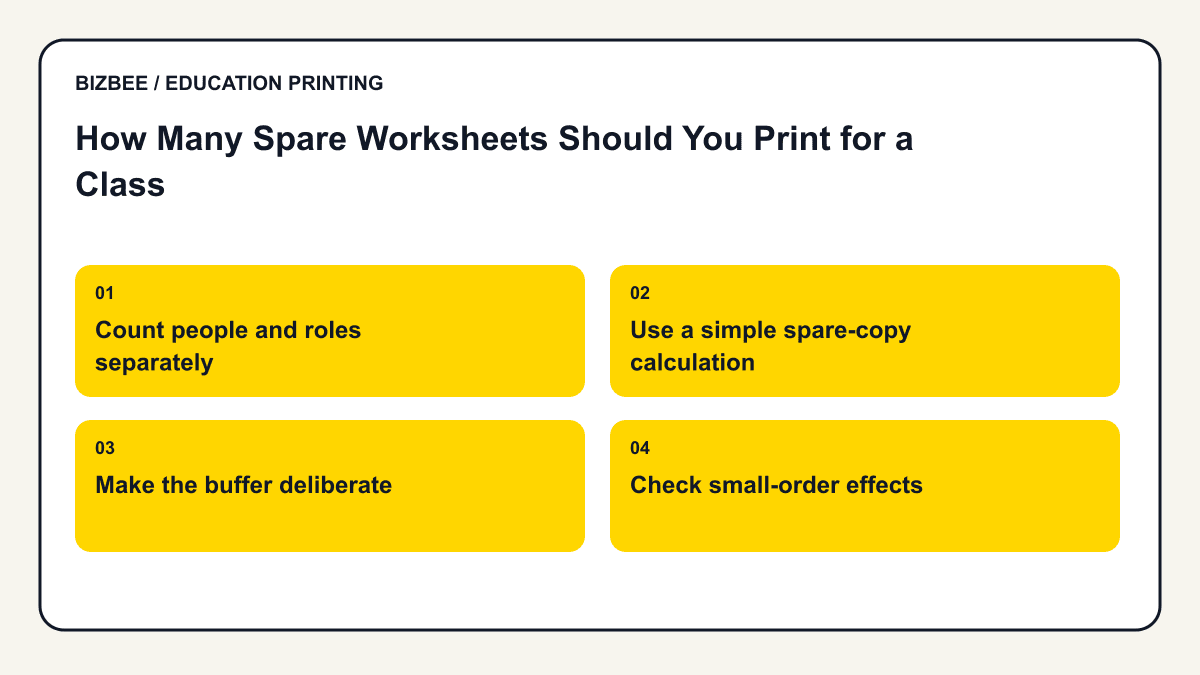
Count people and roles separately
Start with the learners who need their own sheet. Then add any teacher, teaching-assistant or worked-example copy. Shared group activities need a different quantity from individual assessment practice, so do not use the class register mechanically.
Keep an answer key out of the learner file. Its quantity may be one or two even when the pupil resource needs thirty copies.
Use this supporting guide for the underlying print setup; the education workflow above defines this article’s specific task.
Use a simple spare-copy calculation
Illustrative example: 28 pupils need a three-page activity. Add two spare learner packs and one teacher pack using the same file: 31 × 3 = 93 printed faces. If every set is separate duplex, each needs two sheets, giving 62 physical sheets.
If the teacher instead uses a different annotated file, count 30 learner sets and one separate teaching file. That avoids repeating annotations across every pupil copy. The example defines quantity only, not a price or automatic set-handling arrangement.
Make the buffer deliberate
An activity involving cutting, glue or several loose sheets may merit more replacements than a reading page used once. A stable attendance list needs a different buffer from an open workshop. Use previous actual usage if available, but do not invent an attendance forecast.
For repeated lessons, note how many spares remained unused. That observation is more useful than preserving an arbitrary buffer forever.
Check small-order effects
A few extra faces can change the current quote through discounts or minimums; the change is not necessarily linear. Compare the final quantities in the builder, including Dubai delivery, before selecting the buffer. Do not order more than needed merely because the per-page figure looks lower. Store any retained copies with the version date so they are not reused after instructions change.
Find related classroom, student and academic planning questions.
Your decision checklist
- - Count individual versus group use
- - Add staff copies explicitly
- - Choose and record spares
- - Round sheets per set
- - Record leftover copies after the lesson
Frequently asked questions
Is ten percent always the right spare quantity?
No. Use the class, activity and observed replacement needs.
Should teacher copies receive pupil settings?
Only if the content and physical use are the same. Annotated versions need separate review.
Next step
Upload the approved file, compare the current quotation and check available delivery before paying. Specific finishing and handling need confirmation.
Review BizBee document options