Business Cards / 13 min
What Happens After You Order Business Cards Online In Dubai?
A step-by-step guide to business-card artwork checks, proof approval, printing, finishing, packing and delivery coordination in Dubai.
Published / Updated
By BizBee. Factual review: BizBee operations.
Short answer
After a business-card enquiry, the print team checks artwork, confirms size, paper, finish, quantity and deadline, sends or confirms a proof, then prints, finishes, packs and coordinates handoff. The process moves fastest when the customer sends one approved PDF, clear quantities, delivery area and written approval.
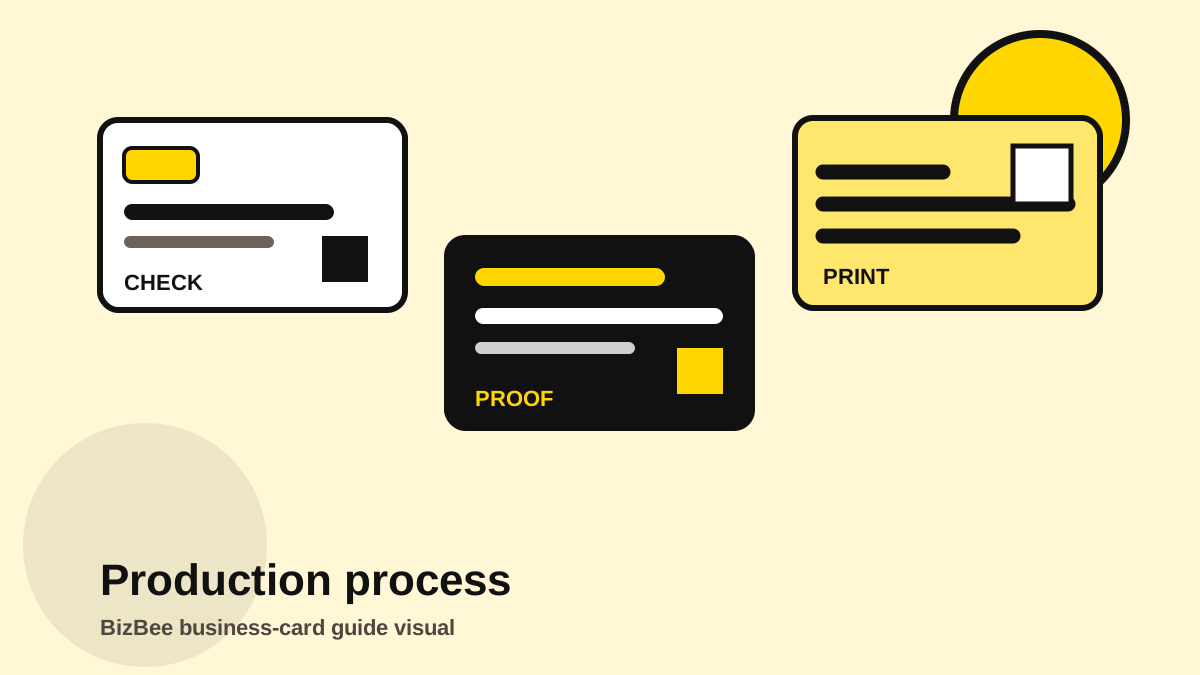
Stage 1: enquiry intake and quote clarification
The process starts with the enquiry, not the printer. Operations needs to understand quantity, versions, deadline, paper, finish, size, delivery area and whether the file is final or still needs design help.
If those details are missing, the first stage becomes clarification instead of production. That is why a complete business-card brief often saves more time than asking for a quick price with no file or finish details.
A good intake also catches operational risk early: urgent event deadline, multiple employee versions, special finish expectations, or cards that need a material not currently stocked.
Use the main guide to make the enquiry quote-ready.
Stage 2: artwork preflight
Preflight is the technical check before approval. The team checks whether the file opens correctly, whether the size is clear, whether the logo is sharp, whether text is inside the safe area and whether bleed exists for edge-to-edge colour.
This is also where obvious issues get flagged: a QR code that is too small, phone number sitting near the edge, fonts converted badly, low-resolution screenshots or a back side that is missing from the PDF.
Preflight does not replace customer proof approval. It simply reduces the chance that a print problem slips through before the proof is reviewed.
Stage 3: proof approval
The proof is the version everyone agrees to print. It should show the actual front and back, final names, final phone numbers, final QR code placement and final visual hierarchy.
For one card, approval is simple. For team batches, approval can become the bottleneck because every name, role and phone number must be checked. A single wrong digit can waste the full batch.
Approval should be written and tied to the exact file. If someone sends a new file after approval, treat it as a new proof cycle rather than assuming the old approval still applies.
Use the information checklist before proof approval.
Stage 4: print and finishing
Once approved, production can move into printing. Standard cards are more predictable than specialist stocks or finishes. Premium effects, unusual materials, rounded corners, lamination, plastic or heavy stock may change lead time and availability.
Finishing deserves respect because business cards are judged in the hand. Cutting, alignment, surface feel and version separation matter. A card that looks good as a flat PDF can still feel cheap if paper and finish are wrong for the purpose.
If the card is for a launch, trade show or sales visit, build in time for finishing and packing instead of assuming printing alone is the full job.
Stage 5: packing, version control and delivery
Packing is especially important for staff batches. Names and quantities should not be mixed. If the order includes branches, teams or different titles, the handoff should make it easy to distribute cards correctly.
Delivery or pickup details should be confirmed before the job is ready. Dubai delivery timing can depend on area, building access, reception instructions and whether someone is available to receive the package.
The final operational question is whether the customer knows what they are receiving: quantity, versions, finish, delivery method and any known limitations. Clear handoff prevents support issues after production.
Industry use cases can decide packing and delivery priorities.
How customers can speed up production
Send one final PDF, not scattered screenshots. Include quantity, sides, finish, deadline, delivery area and the person who can approve the proof. If there are multiple names, send a clean list or table.
Avoid changing details after proof approval unless the change is essential. Late changes restart checking and can threaten the deadline.
If you are not sure whether the artwork is print-ready, say that upfront. It is better to ask for a file check than to pretend the design is final and discover problems during production.
Use the complete guide to structure your enquiry.
Visual proof
Production timeline visual
Show the customer why proof approval sits before print, finish and delivery.
Production handoff checklist
- - Final PDF approved and attached.
- - Quantity, versions and names confirmed.
- - Paper, finish and size confirmed.
- - QR codes scanned from the final proof.
- - Approval deadline and delivery deadline separated.
- - Delivery area, contact person and receiving instructions confirmed.
Frequently asked questions
When does production time start?
Production timing should start after artwork, quote details and proof approval are complete, not from the first casual enquiry.
Can I change my business-card file after approval?
Yes, but it should be treated as a new proof cycle because the change may affect layout, timing and price.
What slows business-card production down?
Missing files, unclear quantity, unapproved names, QR-code issues, premium finish uncertainty and late artwork changes are common delays.
Why does BizBee keep business cards quote-led?
Quote-led handling prevents customers from buying an option before paper, finish, quantity and turnaround are operationally confirmed.
Make the enquiry production-ready
A complete handoff reduces back-and-forth and protects your deadline. Send the final artwork, requirements and approval contact together.
Send a business-card enquiryNext step
Attach the final PDF and tell BizBee the quantity, finish, deadline and delivery area.
Send a production-ready enquiry